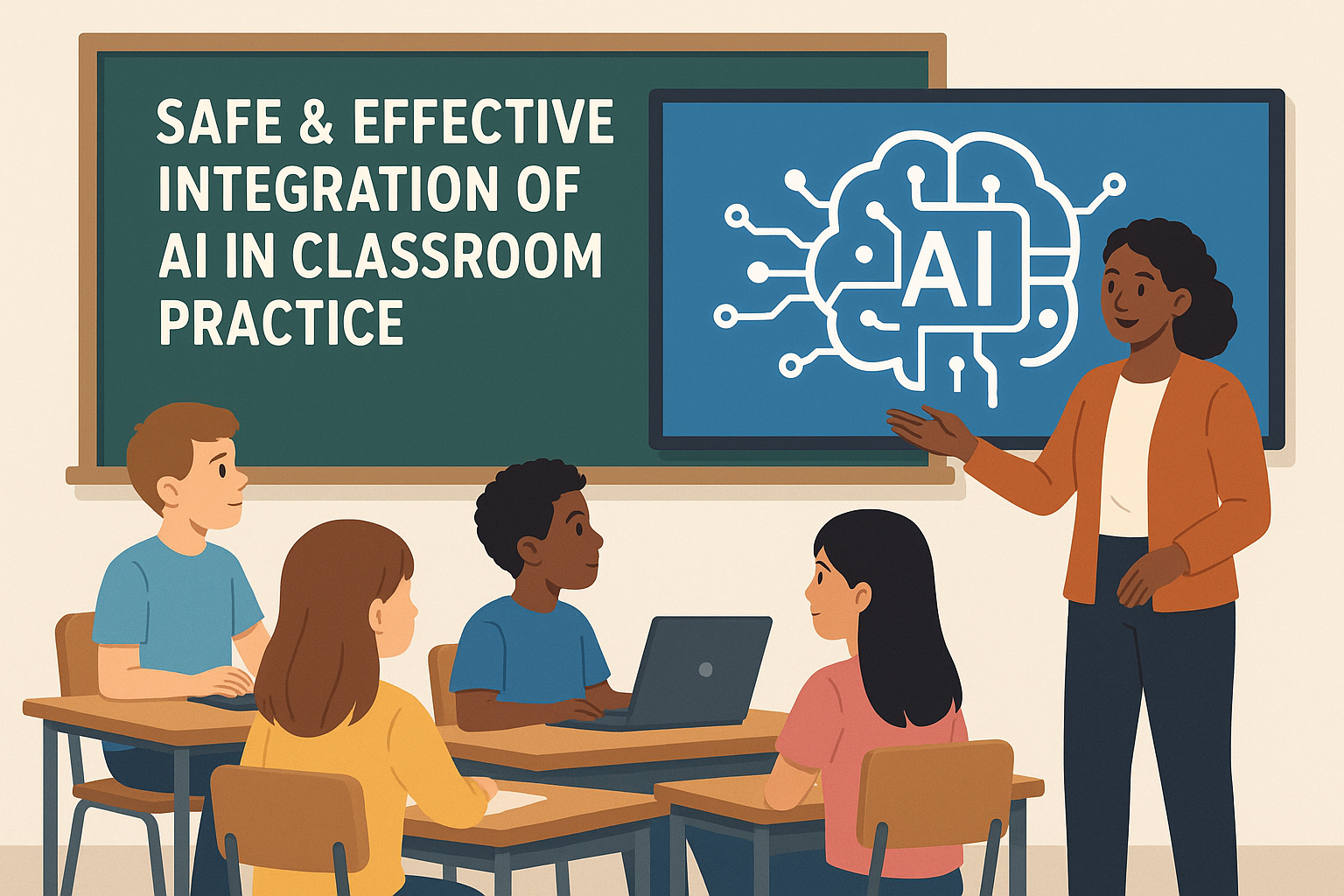
Safe & Effective Integration of AI in Classroom Practice
By Aanya Kapoor
Artificial Intelligence (AI) is gradually becoming a part of Indian classrooms. The challenge today is not whether you should adopt AI in your school but how to implement it safely and effectively. AI in education must improve learning without compromising student privacy, cultural relevance, or teacher authority.
For principals, school owners, and teachers, “safe and effective” means ensuring AI remains a supportive tool while you and your staff maintain full control of teaching and decision-making.
Principles of Safe AI Integration
When you introduce AI into your classrooms, certain principles should guide its use. Protecting student data is the priority. Never share student names, roll numbers, or photos with AI platforms. If a tool requires sign-ups, ensure that your staff use institutional or anonymised accounts.
Transparency is also essential. Students and parents should always know when AI is being used in a lesson, worksheet, or activity. This builds trust and helps learners understand AI as a support rather than an invisible authority.
It is equally important to check AI content for bias. You must review all AI-generated text, images, or questions to ensure they are free from stereotypes and suitable for Indian classrooms.
Applications should also be age-appropriate. For younger students, keep tasks simple. AI might suggest rhyming words for a poem rather than analysing complex material.
Above all, AI must remain teacher-led. It can suggest or draft ideas, but your educators should decide what is relevant and valuable for students.
Steps to Introduce AI Safely in Schools
Rolling out AI requires careful planning and small, deliberate steps.
- Begin with one subject or a simple task, such as generating comprehension questions.
- Always verify AI outputs against NCERT guidelines or trusted textbooks before sharing them in class.
- Earn the confidence of parents. Keep them informed from the start. Regular circulars or meetings can reassure families about how data is protected and how AI supports learning.
- You should also encourage your students to think critically about AI. Ask them to defend, revise, or question the answers AI provides so they don’t see it as the final word.
- To strengthen implementation, hold regular staff meetings where teachers share their experiences, challenges, and best practices.
This collaborative approach can help you identify what works, what doesn’t, and how to adjust your AI strategy over time.
Common Risks of AI in Classrooms
While AI can be a powerful tool, you must also prepare for the risks it brings. One of the most common issues is over-reliance. Learners may start depending too much on AI-generated answers, which can limit their ability to think independently.
So, it’s important to keep reminding students that AI is a tool, not the solution. Encourage them to use critical thinking skills with their own logic.
Accuracy is another concern, as AI can sometimes provide misleading or incorrect information. To avoid this, you need to fact-check all AI outputs with curriculum standards and reliable sources.
Data security is also a serious risk. You should never allow staff or students to upload personal details. You must enforce the use of teacher-controlled or anonymised accounts.
Finally, AI tools can occasionally produce biased or culturally insensitive content. You should carefully review and adapt only those contents that resonate with Indian students and reflect your school’s values. By being proactive about these risks, you can create an environment where AI supports rather than undermines learning.
Practical Classroom Applications
When used under your supervision, AI can make classrooms more adaptive, inclusive, and effective.
- For lesson planning, AI can generate draft worksheets, activity outlines, or reading passages that can be refined to fit the curriculum.
- In the middle of lessons, it can produce quick comprehension quizzes to help you check if students are following along.
- AI also supports differentiated learning by suggesting questions at various levels of difficulty. It allows you to challenge advanced learners while supporting those who need more practice.
- It can help teachers provide feedback by offering initial remarks on assignments, which they can then personalise for each student.
- For homework, AI can generate additional practice questions in subjects like language or math, with your teachers reviewing the material before sharing it.
These applications save time, improve engagement, and align with your school’s academic goals, while keeping you in charge at every step.
NEP 2020 Alignment
The National Education Policy (NEP) 2020 highlights the importance of technology-driven, inclusive, and personalised learning. By adopting AI responsibly, you align with this vision while also meeting your duty to ensure fairness, privacy, and transparency.
Platforms such as DIKSHA already demonstrate how AI can be integrated into digital learning environments, showing that AI adoption is not about replacing teachers but about supporting them in building stronger, more adaptive classrooms.
To conclude, AI has the potential to transform your classrooms, but it must be used with responsibility and care. For you as a school leader, safe and effective integration means protecting student data, keeping teachers in control, ensuring no bias, and encouraging students to think critically rather than accepting AI outputs at face value.
By starting small, verifying AI-generated material, and using it mainly for supportive tasks like lesson planning, quick assessments, and differentiated learning, you can equip both your teachers and students to use AI wisely. Most importantly, AI should remain a tool in the teacher’s hands, never a replacement for their expertise.
As India expands its digital education initiatives, schools that integrate AI responsibly not only align with the National Education Policy (NEP) 2020 but also prepare their students with the skills they need to thrive in a technology-driven future.
The author is a content marketer with Extramarks.