How Eco-Clubs in Schools under NEP 2020 are shaping student awareness and promoting sustainability
By Prangya Jyoti Samal
The introduction of the New Education Policy of 2020 was revolutionary in the field of pedagogy itself. From early childhood to higher education, there were subsequent changes in the structure along with the integration of new concepts, which are crucial for a child’s holistic development. One such addition was the introduction of Eco-Clubs at the school level. J.S. Mill, a renowned political theorist, considered the human mind as ‘Tabula Rasa’, which means a child’s mind is like a ‘clean slate’. As we grow up, our experiences and learning build up our perception. Therefore, understanding sustainability from the initial years encourages the development of environmental literacy and provides children with the tools they require to become change agents in their communities. [Kumar, 2025]
Why Schools Need Eco-Clubs
The environment is like an extended home, just as one finds comfort and relief at home after a tiring day. A healthy and balanced environment provides us with a similar sense of peace, security, and well-being. It nurtures us with clean air, pure water, fertile soil, and countless resources essential for life. Unfortunately, we often take these things for granted, which affects our own survival. This growing disconnect between anthropogenic activities and environmental well-being creates a need for environmental awareness and responsibility from a young age. Eco-Clubs are an effective medium through which we can bridge this gap.
Studies conducted on the level of awareness of Eco-Clubs regarding the environment in Trivandrum, Kerala revealed that integrating comprehensive environmental studies as part of the core curriculum enriches students’ practical knowledge. From 3rd standard onwards, students receive theoretical knowledge as part of their environmental studies (EVS) syllabus, but they often fail to apply it in reality.
Proactive methods for dealing with environmental problems come to students when they actually work in the field beyond their textbooks. Students take initiatives and gain first-hand experiences through these field activities, which they implement in their day-to-day life. This research suggests the need for conducting eco-training, appointing Eco-Club coordinators in schools, and providing them with resources and funds that will support their ambitious and futuristic programs. [Ray, Prabhu, Champettil, and Krishnan, 2025]
Policy and Institutional Framework for Empowering Eco-Clubs
Every initiative requires a kick-start, and in the context of environmental education, the Ministry of Environment, Forest and Climate Change launched the Environment Education, Awareness and Training (EEAT) scheme. Under this scheme, over 100,000 Eco-Clubs have been established in schools and colleges to educate students and promote environmentally friendly activities. The principal objective is to adopt healthy lifestyles, choose sustainable food systems, reduce waste (including e-waste), and avoid single-use plastics. Funding was allocated to key programmes such as the National Green Corps (NGC), National Nature Camping Programme (NNCP), and Capacity Building Activities (CBA).
The National Green Corps (NGC) implemented the Eco-Club initiative across approximately 1,20,000 schools in India. Each Eco-Club typically comprises 30–50 student members, referred to as NGC Cadets, who engage in projects related to biodiversity, water and energy conservation, waste management, and sustainable land-use planning.
The National Nature Camping Programme (NNCP) offers students exposure to nature through camps and field visits, while CBA focuses on skill development among students and teachers related to biodiversity, conservation, waste management, SDGs, and climate issues.
In 2022–23, the EEAT scheme was revamped into the Environment Education Programme (EEP) under the Central Sector Scheme ‘Environment Education, Awareness, Research and Skill Development (EEARSD)’. This shift aimed to strengthen environmental literacy by implementing Eco-Clubs in 12 states and UTs. The EEP promoted workshops, exhibitions, competitions, and campaigns that sensitized young learners and encouraged sustainable lifestyles.
State-wise funding between 2018–2023 shows significant government investment, with states like Madhya Pradesh, Gujarat, Karnataka, and Assam receiving major allocations. This financial and institutional backing has given Eco-Clubs the initial push and sustained support they need to foster environmental consciousness at the school level.
Sustainability in Action
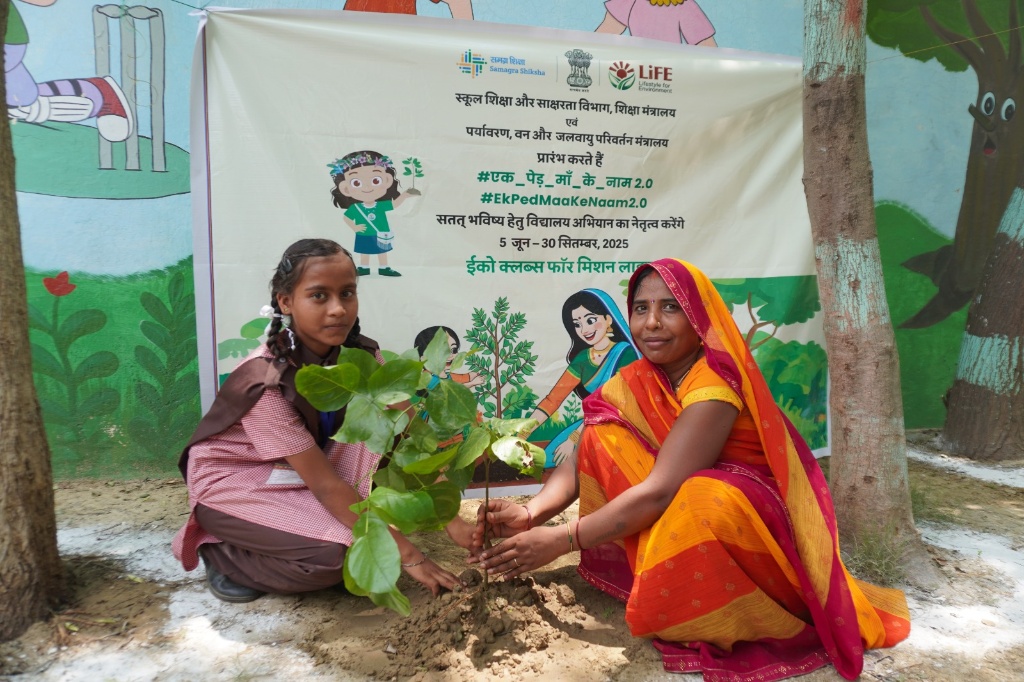
Five years after the introduction of the New Education Policy, Eco-Clubs for Mission LiFE (Lifestyle for Environment) brought subsequent changes to the school curriculum. According to MoEFCC’s study on Eco-Clubs in schools, environmental awareness levels among students were observed to be 20–30% higher in schools with active Eco-Clubs. Over 60% of schools reported that Eco-Club activities led to increased community participation through campaigns and drives.
Various schools across the country have chosen to promote sustainable practices. One such example is Bal Bharti School, situated in West Delhi, Dwarka, which adopted a NO PLASTIC ZONE and ‘dustbin-free classrooms’ on its campus to educate students about waste management. Alongside this, students are taught the importance of organic farming through a designated area of the school playground for growing vegetables and herbs. The school focuses on UN Sustainable Development Goals: SDG 4 (Quality Education), SDG 6 (Clean Water and Sanitation), SDG 11 (Sustainable Cities and Communities), SDG 12 (Responsible Consumption and Production), SDG 13 (Climate Action), and SDG 15 (Life on Land).
Gajera International School, Surat, Gujarat, organized Earth Day rallies on June 5th to raise awareness about biodiversity loss. Activities included bird nest making, leaf punching, and “best out of waste” projects. These events not only connect children to nature but also nurture their curiosity and engagement with the environment.
Challenges and Road Ahead
During my undergraduate years, I had the opportunity not only to be a member of an Eco-Club but also to lead the team. This experience gave me firsthand insight into both the potential and challenges of such initiatives. One major challenge I personally faced was the lack of environmental awareness and engagement among students. For many, Eco-Clubs were narrowly perceived as participating only in plantation drives or cleanliness campaigns, activities that, while important, often failed to capture their interest or convey the broader purpose of environmental action.
To address this, there is an urgent need for structured awareness campaigns that go beyond traditional activities. Interactive workshops, field visits, peer-led sessions, and real-life problem-solving projects can make environmental issues more relatable and meaningful. By showcasing how Eco-Club initiatives connect to larger concerns like climate change, sustainability, and community well-being, students can be inspired to take ownership and become active contributors rather than passive participants. Eco-Clubs now need to evolve.
They must shift from an activity-based approach to one focused on environmental leadership and innovation. Linking Eco-Club work to national missions like Mission LiFE and the UN Sustainable Development Goals provides students with a sense of purpose and global connection.
Additionally, inadequate funding and resource distribution remains a persistent issue. Around 35% of schools reported delays or irregularities in receiving funds, most of which are rural schools. Enhanced funding and monitoring mechanisms are crucial for accountability. Creating incentive structures such as Green School Awards, Student Fellowships, and Inter-School events can motivate both teachers and students to become torchbearers of environmental awareness.
The New Education Policy 2020 (NEP) is a transformative step in reshaping India’s education system. Considering its role in environmental concerns, it demonstrates that “positive seeds grow lasting forests.”
A famous Native American proverb states: “We do not inherit the Earth from our ancestors; we borrow it from our children.” The initiative of introducing Eco Awareness and Mission LiFE fosters eco-saviours who can help restore the Earth’s balance and harmony.
Prangya Jyoti Samal is a Policy Advocacy & Research Intern at SarkariSchool.in. She has served as the Vice President of Palaash – The Eco Club of Bharati College, University of Delhi, and is currently pursuing a Master of Arts in Political Science from the Department of Political Science (South Delhi Campus), University of Delhi. Please share your comments at [email protected].
References:
- Kumar, L. (2025). NEP 2020: Challenges, opportunities, strategies, and implementation.https://books.google.co.in/books/about/NEP_2020_Challenges_Opportunities_Strate.html?id=zL9kEQAAQBAJ&redir_esc=y
- Ray, A., Prabhu, V. A., Champettil, M. K., & Krishnan, P. H. (2025, February). Role of eco-club in fostering environmental sustainability awareness among school students. Salud Ciencia y Tecnología – Serie de Conferencias,4,1403. https://www.researchgate.net/publication/388991467_Role_of_Eco-Club_in_Fostering_Environmental_Sustainability_Awareness_Among_School_Students
- EcoSchools. (2023, June). Success stories: ESP 2022–23. EcoSchools. https://www.ecoschools.in/wp-content/uploads/2023/06/Success-Stories-ESP-2022-23-1.pdf
- Ministry of Education, Government of India. (2025). Eco Clubs for Mission LiFE. Retrieved August 9, 2025, from https://ecoclubs.education.gov.in/
- Ministry of Environment, Forest and Climate Change. (2023, July 27). Central fund for environmental awareness (Unstarred Question No. 851, Rajya Sabha). Government of India.
- Ministry of Environment, Forest and Climate Change. (2019). Evaluation study on eco-clubs in schools. Government of India. https://moef.gov.in/en/resources/reports/evaluation-study-on-eco-clubs-in-schools/