Educated but Unemployed: Bridging the gap between education and employment in India
By Sakshi Upadhyay
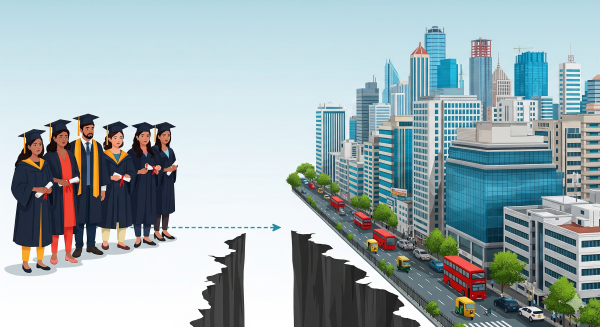
India is home to one of the largest youth populations in the world, often celebrated as its “demographic dividend”, yet a paradox exists – India produces lakhs of engineers, MBA’s and graduates annually still the unemployment rates stand at 6.77%. A crucial question is brought up by the growing gap between education and employment: Are we giving our students the skills needed by the market?
The Market Skills mismatch
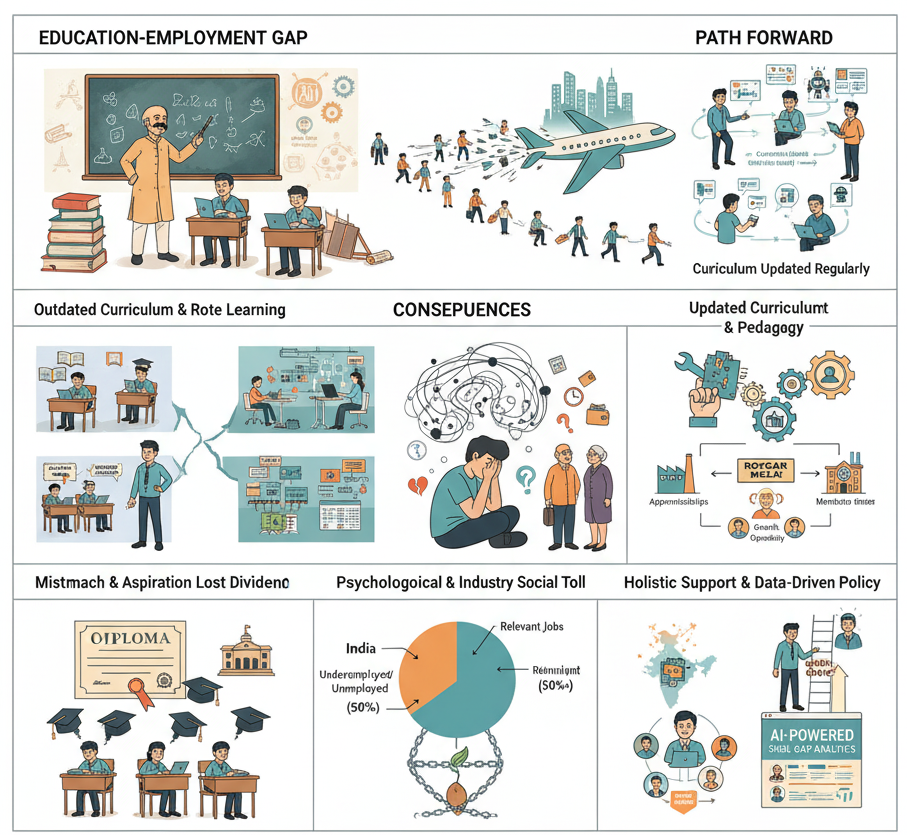
The problem starts at the grassroots level. The curriculum is outdated and has not changed in years. It promotes rote memorization and test-focused learning instead of preparing students for evolving industries like AI, data science, green energy, and fintech. By the time the academic syllabus is updated, market demands have already changed. Schools and colleges also offer few opportunities for internships or apprenticeships, even though employers increasingly want practical experience. Consequently, graduates often have only textbook knowledge. As per the Economic Survey 2024-25, only 8.25% of graduates have jobs matching their qualifications, over 50% of graduates and 44% of undergraduates are underemployed in lower job roles.
During job interviews, employers give importance to skills such as communication, digital literacy, critical thinking, problem solving, and adaptability which are rarely emphasized in classrooms. For instance, a student aspiring to pursue a PhD in Economics requires strong mathematical training, but many colleges fail to provide this foundation, leaving students underprepared for advanced research.
Additionally, there is a mismatch between employability and qualifications because of society’s emphasis on degrees, regardless of their market usefulness. To break the common notion, there are now more ed-tech platforms that emphasize skills over degrees and provide training in in-demand fields like data science, UI/UX design, and many more. The imbalance is intensified by the lack of early career counselling, which leads to a ton of graduates in crowded industries like engineering and MBA’s while there are shortages in developing industries like artificial intelligence, renewable energy, and healthcare. The challenge is even more severe in rural areas, where education quality and exposure remain poor, making it difficult for students to compete in urban job markets.
Policy frameworks like the NEP 2020 have recognized the need for skill integration and flexible learning, but their on-ground implementation has been slow. Moreover, many teachers and professors are not adequately trained or updated with evolving industry trends, further widening the gap. Recent studies indicated that highly educated youths, aspire to get “Sarkari Naukri” that provides better socioeconomic prospects. These aspirations are driven by societal aspirations, career expectations, and the desire for upward social mobility. As a result, the high unemployment rate among youths may be partly due to aspirations for white-collar jobs, which are not available in sufficient quantity. (IER 2024)
The Aftermath
In the economic sense, it has become increasingly common among the youth to move abroad for studies in search for a diverse curriculum and high exposure to the real world and eventually settle in foreign countries leading to brain drain and the wastage of human capital. The situation is even worse for women, as they face double deprivation, resulting in lower female labour force participation and, consequently, slower economic growth. Government often subsidizes higher education and despite this, if youth is unable to get a job it leads to wastage of public investment. Although India is known for its demographic dividend, the high underemployment rate among graduates can turn this dividend into a liability.
Psychologically, educated unemployment often causes frustration, anxiety, and resentment. To become market-ready, many youths are forced to take additional courses beyond a three- or five-year degree, which further postpones their financial independence and disrupts their personal lives. A study titled “Educated Unemployed Youth and Psychological Distress” surveyed 400 young adults (equally divided by gender) and found that unemployed youth reported significantly higher levels of anxiety, depression, tension, anger, and sensitivity compared to their employed peers, highlighting the profound mental health challenges associated with unemployment.
Socially, middle class are more susceptible to educated unemployment which causes increased social unrest and leads to dependency on family and often delays marriage and family planning causing social alienation. It also reinforces the cultural norm of “Padh kar kya fayda jab naukri nahi milegi?” which indirectly discourages others to pursue education.
Ongoing Efforts
To realize the demographic dividend the Government of India has planned investment in skills development via various schemes. Pradhan Mantri Kaushal Vikas Yojana (PMKVY) which is the flagship programme run by the Ministry of Skill Development & Entrepreneurship (MSDE) offers free short-term training in industry-relevant skills across sectors. A new system called Recognition of Prior Learning (RPL) has been introduced where workers who already have the skills (but no certificates) can get officially recognized. The government also holds job fairs (Rozgar mela) to connect trained youth with potential employers. Under the National Education Policy (NEP 2020) there is a clear push towards learning 21st century skills. Subjects like Artificial Intelligence, Machine Learning, Robotics, and coding has been introduced since middle school. Through this policy the government aims to shift the focus from exam-based learning to skill-based learning. Another important effort is Skill India Mission launched in 2015 to train over 40 crore people in different skills. As per the Press Information Bureau as of 2024 over 1.60 Cr candidates have been trained or oriented under the mission revealing the extent to which the mission is bridging skill gap in India. On the regional level, Uttar Pradesh has developed an AI powered “UP Skill Gap” dashboard which uses machine learning and real time analytics to find out the skills in demand across various districts. Therefore, steps taken on national level encourage the states to develop a policy on the similar lines that suits their needs.
The Road Ahead
If India truly wants to make use of its demographic dividend the focus must be on speeding up implementation and making the system more responsive and efficient. Aligning the educational curricula with industry needs to make sure graduates possess the skills required by market is also important, we must take lessons from Wales (UK) where the curriculum is updated every four years providing schools with more flexibility and latest content.
Another important area is teacher training. The updated curriculum will not make a difference if the teachers themselves are not trained adequately, the training period should not be treated as free labour and must be paid for. Only then the teacher will feel motivated to pass on the learned knowledge to the students. Additionally, there is a need to foster stronger partnerships between educational institutions and the industrial sector. Better data collection on youth aspirations and industry demand would also help in tracking changing trends in the job market. This would give young people the necessary exposure to diverse career pathways. Instead of being qualified yet unemployed and spending years preparing for limited government job openings, students could identify alternative opportunities and perform better in sectors where their skills are needed.
Lastly, providing better opportunities for growth, higher salaries and reducing the tax burden in India would help in minimizing the brain drain of youth. Presently, the government’s actions are heading in the right direction, but we need more focused efforts and quicker implementation to create real change. With the right balance of policy, skill development, and innovation, India’s youth can be made job-ready.” By implementing these policy recommendations, India can leverage its demographic advantage to build a more inclusive and prosperous future for its youth. This will not only strengthen our workforce but also help India achieve its vision of becoming a global knowledge leader, a true ‘Vishwa guru’.
A proud KV alumnus, Sakshi is working as Team Coordinator, Policy Advocacy and Research at SarkariSchool.in. She has completed her Master’s in Economics from St. Mira’s College for Girls, worked with KPMG, and is passionate about contributing to the field of Public Policy and Research. Please write your comment at [email protected]
References
Indian Employment Report (IER) (2024). India Employment Report 2024 Youth employment, education and skill. ILO and IHD- https://www.ilo.org/publications/india-employment-report-2024-youth-employment-education-and-skills
Mehta, B. S., & Awasthi, I. C. (2025). Linkage between youth education, skill, and employment. In Indian youth’s journey from education to decent work (pp. 115–148) –https://link.springer.com/chapter/10.1007/978-981-96-4475-9_5#citeas
Sinha, P. (2013). Combating youth unemployment in India (p. 7). Friedrich-Ebert-Stiftung-https://scholar.google.com/scholar?hl=en&as_sdt=0%2C5&q=youth+unemployment+in+india&btnG=
Mehta, B. S., & Awasthi, I. C. (2025). Policy Recommendations for Youth Education, Skill, and Employment. In Indian youth’s journey from education to decent work (pp. 181–197)-https://link.springer.com/chapter/10.1007/978-981-96-4475-9_5#citeas
Government of India, Ministry of Finance, Department of Economic Affairs. (2025). Economic Survey 2024–25 (Statistical Appendix, Table 8.12, 361-365)-https://www.indiabudget.gov.in/economicsurvey
Biswas, M. M., Das, K. C., & Sheikh, I. (2024). Psychological implications of unemployment among higher educated migrant youth in Kolkata City, India. Scientific Reports, 14, Article 10171-https://doi.org/10.1038/s41598-024-60958-y
Government of India, Ministry of Education. (2020). National education policy 2020. Ministry of Education-https://www.education.gov.in/sites/upload_files/mhrd/files/NEP_Final_English_0.pdf