
The State of Tribal Education in India: Challenges, Initiatives, and Progress
By Mehak Aulakh
Purnima Huika, 16, from the Dongria Kondh tribe … “the mountain is God’s abode.” There was no school near home, so she enrolled in an Ashram. Her parents resisted at first, until they were promised food rations. “Slowly,” she said, “I started to like that environment.” Eventually she and thirteen others became the first women of their tribe to complete the tenth grade. Her educational journey became a symbol—both of hope and the tensions between assimilation and identity.
Just like Purnima, there are millions of Scheduled Tribe children who aspire to seek education and equal opportunities. Some succeed, while many continue to struggle. This sheds light on the broader perspective of cultural and educational gap faced by Scheduled Tribe children.
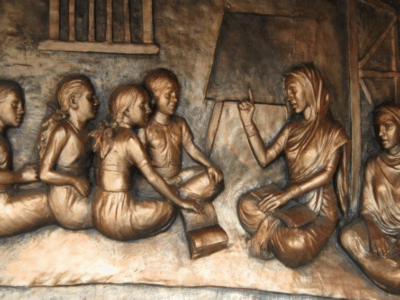
The concept of the Ashram school marked the first organized step towards integrating tribal children into the mainstream education system. These residential schools, often situated close to tribal hamlets, provided food, shelter, helping to bridge the divide between traditional life and formal schooling. For many first-generation learners, Ashramshalas became the platform to seek higher education in independent India.
Over the decades, this model evolved into more structured initiatives like government primary schools, scholarships, and more recently, Eklavya Model Residential Schools (EMRS) and provisions under the Right to Education Act and National Education Policy 2020. The journey from ashrams to modern classrooms reflects the sheer determination of Scheduled Tribe children to learn, grow and seek equality. But this journey was filled with challenges including high dropout rates, inadequate resources, and the struggle to balance cultural identity with educational assimilation.
This article traces that journey of tribal education in independent India. It examines the historical shift from Ashramshalas to modern classrooms, highlights key government schemes, and explores possible ways forward to ensure that tribal children not only enter classrooms but thrive within them.
Current Educational Landscape
Home to more than 1.42 billion people, India is one of the largest low- and middle-income countries, with a tribal population of approximately 104 million, accounting for around 8.6% of the country’s total population.
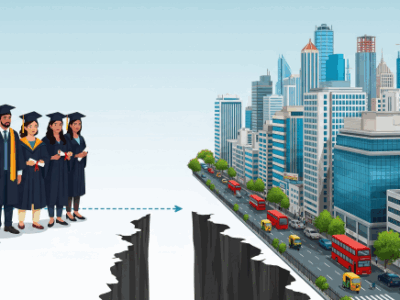
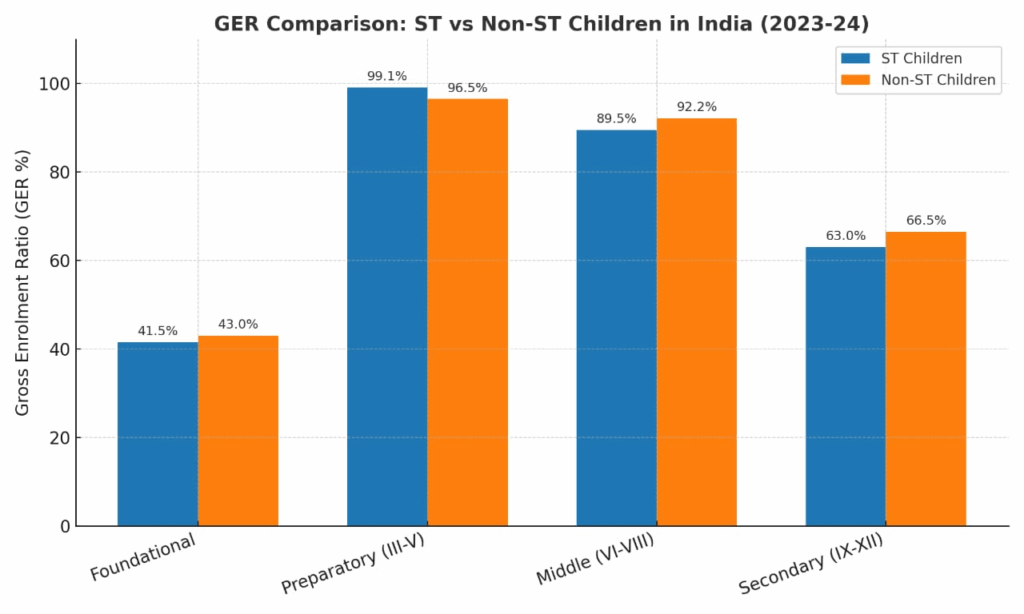
Scheduled tribes constitute the statutorily weaker section of society. While enrolment of total scheduled tribe children has significantly improved at the foundational and preparatory stages, often matching or even surpassing nonscheduled tribe children, the gap widens at higher levels. Total scheduled tribe enrolment drops sharply at the middle and secondary stages, whereas nonscheduled tribe children maintain relatively steady participation. This indicates that although access has improved for total scheduled tribe children, ensuring retention and smooth transition to higher classes remains a critical challenge.
In 2023–24, the GER for ST children stood at 99.1 at the preparatory stage (Classes III–V), surpassing that of non-ST children (96.5). However, enrolment for ST children dropped to 89.5 at the middle stage and further to 63.0 at the secondary stage, remaining below the corresponding non-ST GER (92.2 and 66.5, respectively)
The government’s recent focus on tribal welfare reflects a holistic approach to empowerment, where education, health and livelihood development are being advanced simultaneously. The Dharti Aaba Janjatiya Gram Utkarsh Abhiyan, launched on October 2, 2024, with an outlay of over ₹79,150 crore, seeks to bridge longstanding gaps in tribal villages by strengthening social infrastructure and livelihood opportunities.
Within this larger framework, education has been prioritized as the foundation for the betterment of Scheduled Tribe children. The expansion of Eklavya Model Residential Schools (EMRS) with 40 schools inaugurated and 25 more under construction at an investment of ₹2,800 crore represents a critical step toward ensuring quality education for marginalized tribal youth. These schools, modeled on the standards of Navodaya Vidyalayas, not only provide academic training but also preserve tribal culture and promote sports and skills, ensuring a balanced development pathway for tribal youth.
Alongside these educational reforms, the government has advanced initiatives under the Pradhan Mantri Janjati Adivasi Nyaya Maha Abhiyan (PM-JANMAN). With projects worth ₹1,360 crore, PM-JANMAN focuses on critical enablers such as road connectivity, Anganwadis, multipurpose centers, and school hostels creating an ecosystem in which education can flourish.
From Margins to Mainstream
Though the journey of tribal education began with ashram schools, over time efforts were made to include modern education and curriculum so that ST children could also benefit from the formal schooling. Government of India had a clear vision of making inclusivity possible for everyone, beginning with the National Policy on Education of 1968, which was the first comprehensive policy of independent India. This policy emphasized on the educational opportunities, including Scheduled Tribes, and recognized the importance of establishing schools, particularly in remote areas. Following this, the National Policy on Education of 1986 sought to address the disparities and special emphasis was given on tribal communities. The inclusion of tribal languages in curricula was also a major step aiming to create a culturally sensitive educational framework. By broadening representation of tribal students, the government made sure that tribal children don’t feel isolated from the mainstream education platform. The National Education Policy of 2020 laid out plans facilitated the entry of talented and deserving students from Particularly Vulnerable Tribal Groups (PVTGs). Beyond education, it also aimed at their socio-economic development.
Since most tribal communities have historically faced economic disadvantages, monetary support has been crucial in ensuring that children from these groups can access education. Over the years, the government has implemented several scholarship schemes to address this need. It began with the Pre-Matric Scholarship, aimed at students up to class 10, which helped reduce dropouts by providing financial assistance to families with limited income. This was followed by the Post-Matric Scholarship, which supported students pursuing education beyond class 10 and reimbursed tuition fees along with providing monthly maintenance allowances.
To encourage higher education, the National Fellowship for Higher Education was introduced, offering fellowships to M.Phil. and Ph.D. students along with contingency grants, while the National Overseas Scholarship enabled a select number of tribal students to pursue postgraduate and doctoral studies abroad. Additionally, the Top Class Education Scholarship supported meritorious tribal students in premier institutions in India by covering tuition, living expenses, and other allowances. Collectively, these initiatives have significantly reduced financial barriers, and created opportunities for academic advancement across generations.
Battles beyond the Classroom
Tribal children continue to face several challenges despite the various policies and scholarships in place. One of the most significant is the socio-economic barrier, as many tribal families live in poverty and struggle to meet basic needs, making education a distant dream. Another major challenge is the language barrier, since most tribal communities speak their own dialects, teachers and volunteers who speak English have a hard time explaining concepts to the children. Many schools lack adequate amenities like clean water facilities, stationary, clean toilets. While policies are designed to bring change, their effective implementation depends on actions and transparency by those incharge. Without this, scholarships and policies alone cannot make a meaningful impact. Bridging these gaps is essential not only to help tribal children excel academically but also financially, help uplift their families, and move beyond the isolation.
A Ray of Hope for Inclusion
It is important for non-tribal communities to respect and value the indigenous culture of tribal people, without intruding into it. A true sense of belonging brings people closer together. If tribal communities feel isolated, steps must be taken to address this. With the permission of residential school authorities, volunteers can engage with ST children learning about their culture, sharing modern opportunities, informing them about scholarships, etc. Their culture should not only be respected but also celebrated, ensuring they feel a sense of belonging and pride.
Cultural exchange programs can be organized where Scheduled Tribe children showcase their talents through songs, folklore, and traditions. Such initiatives foster mutual respect between communities. Another meaningful step could be pairing ST students with mentors from universities and NGOs, who can guide them on approaching higher education, inform them about available scholarships, and support them in applying to reputed institutions.
Lighting the Path Ahead
Commendable progress has been made to include Tribal children in the mainstream education process yet the decline at the upper primary stage underscores the fragility of this progress. It is crucial for the government to ensure the effective implementation of all policies designed for tribal communities. Increasing the percentage of educated tribal individuals is essential for promoting true inclusivity and giving young tribal children the opportunities they deserve. In order to witness real growth, it is crucial to include quality housing, improve living standards of Scheduled Tribe families. The sensitization of non- tribal population is also very essential in this process of inclusivity. Despite language barriers and years of isolation, education has reached the roots of tribal children and it will continue the path of advancement and inclusion.
Mehak is a Policy Advocacy and Research Intern at SarkariSchool.in and is currently pursuing her Master’s in Sociology at Panjab University, Chandigarh. Please write your comment at [email protected].
References
- Chaudhari, A. K. (2023). Problem of tribal education: Issues & challenges. International Journal for Research in Applied Science & Engineering Technology, 11(7), 1265–1267. https://doi.org/10.22214/ijraset.2023.54858
- Nanjunda, D. C. (2019). Ignored claims: Ashram schools and the quality of tribal education in India. IIS University Journal of Social Sciences, 7(1), 1–13. http://iisjoss.org/sites/default/files/iisjoss/2018-19/PDF/1.pdf
- Deep, S. S. (2020). Educating tribal children in India: Challenges and development. International Journal of Humanities and Social Science Research, 6(4), 45–50. https://www.socialsciencejournal.in/assets/archives/2020/vol6issue4/6-4-13-699.pdf
- Negi, S., & Dutta, I. (2022). Development initiatives and tribal education in India. Mekal Insights, 6(1–2), 47–56. https://igntu.ac.in/MekalInsight/Vol6-Issue1-2-year-2022/6.pdf
- Upmanyu, M. C. (2016). The tribal education in India: Status, challenges and issues. International Journal of Novel Research in Education and Learning, 3(6), 96–102. https://www.noveltyjournals.com/upload/paper/The%20Tribal%20Education%20in%20India-869.pdf
- Ministry of Tribal Affairs. (n.d.). National fellowship & scholarship for higher education of ST students. Government of India. https://www.myscheme.gov.in/schemes/nfandshests
- Press Information Bureau. (2024, October 3). Government initiatives for tribal welfare in India (Backgrounder No. 153230). Government of India. https://www.pib.gov.in/PressNoteDetails.aspx?NoteId=153230&ModuleId=3
- Rashmi, R., & Paul, R. (2022, June 14). Early childhood circumstances and educational wellbeing inequality among tribal and non-tribal children in India: Evidence from a panel study. Scientific Reports, 12(1), Article 9839. https://doi.org/10.1038/s41598-022-13889-5